







evec EV Chargers Explained: Which Model Is Right for Your Home or Business?
An evec EV charger is a UK EV charge point option for domestic, workplace and commercial charging projects. For most homes, the practical choice is a 7.4kW single-phase wall charger such as the evec VEC01 7.4kW socketed EV charger or the evec VEC03 7.4kW tethered EV charger. For commercial sites with three-phase supply, 22kW wall, dual wall, pedestal or 40kW DC rapid options may be more suitable.
This guide compares the main evec charger UK range by real installation type: homes, workplaces, shared car parks, commercial bays and public-facing charging sites. It also explains when to choose socketed, tethered, 7.4kW, 22kW, pedestal or rapid charging.
Quick comparison table
| evec model | Power / format | Best suited to | Choose this when |
|---|---|---|---|
| VEC01 | 7.4kW socketed wall charger | Domestic single-phase installs | The driver wants a tidy wall unit and will use a separate charging cable. |
| VEC03 | 7.4kW tethered wall charger | Regular home charging | The same Type 2 vehicle parks within reach of the fixed cable. |
| VEC02 | 22kW socketed wall charger | Three-phase commercial or shared sites | The site wants higher AC charging capacity and cable flexibility. |
| VEC04 | 22kW tethered wall charger | Fleet, staff or repeat-use bays | The site has three-phase supply and wants a fixed Type 2 lead ready at the bay. |
| EDW01 | Dual 7.4kW socketed wall charger | Workplaces and shared parking | Two AC charging points are needed from one wall position on a single-phase layout. |
| EDW02 | Dual 22kW socketed wall charger | Three-phase commercial bays | The site needs two faster AC charging points from an existing wall position. |
| ESP01 | 7.4kW single socket pedestal | One freestanding shared bay | There is no useful wall near the parking bay and dwell times are long. |
| EDP01 | Dual 7.4kW socket pedestal | Two shared bays | The site wants two freestanding AC charging points without stepping up to 22kW. |
| ESP02 | 22kW single socket pedestal | Three-phase freestanding commercial bay | A single bay needs faster AC charging away from a wall. |
| EDP02 | Dual 22kW socket pedestal | Higher-demand shared commercial bays | Two freestanding 22kW-capable AC charging points are needed from one pedestal. |
| VEC40DC-S | 40kW single-gun DC rapid charger | One-bay rapid charging | The site needs faster turnaround than AC charging can normally provide. |
| VEC40DC-DG | 40kW dual-gun DC rapid charger | Two-vehicle rapid charging | The site wants one rapid cabinet to serve two vehicles, with output shared when both guns are in use. |
What is an evec EV charger?
An evec EV charger is an electric vehicle charge point for charging plug-in vehicles at homes, workplaces and commercial sites. The evec range includes 7.4kW single-phase wall chargers, 22kW three-phase AC chargers, dual socket wall chargers, freestanding pedestal chargers, 40kW DC rapid chargers and contactless payment terminals.
The main buying decision is not simply “which evec charger is best”. The correct model depends on the available electrical supply, whether the charger is private or shared, how long vehicles usually stay parked, whether a wall or pedestal position is required, and whether access control or payments are needed.
For wider product browsing, see LAMPS’ home EV chargers and commercial EV chargers categories.
Which evec charger is best for home use?
For most UK homes, the best evec charger will usually be a 7.4kW single-phase wall charger. Choose the evec VEC01 7.4kW socketed charger if the driver wants a neater wall unit and is happy to use a separate charging cable. Choose the evec VEC03 7.4kW tethered charger if the driver wants a fixed Type 2 lead ready for regular charging.
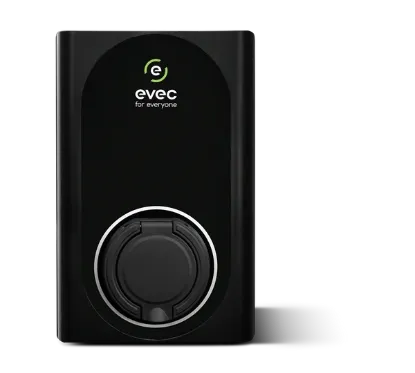
evec VEC01 7.4kW socketed EV charger
The evec VEC01 is the cleaner-looking domestic option because the cable is removable. It suits driveways where the customer does not want a fixed lead permanently on the wall, or where more than one vehicle type may be charged using the correct cable.
It is a good fit for:
- single-phase home charging installations;
- drivers who already carry a suitable charging cable;
- driveways where cable storage needs to stay tidy;
- homes where the vehicle position or cable length may vary.
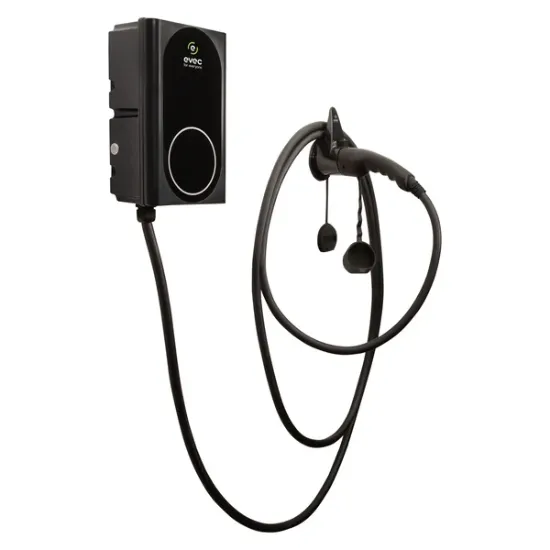
evec VEC03 7.4kW tethered EV charger
The evec VEC03 is the more convenient home option for repeat charging. The fixed Type 2 cable is already attached, so the user does not need to get a separate lead from the boot each time.
It is a good fit for:
- households charging the same Type 2 vehicle regularly;
- driveways where the car parks in a predictable position;
- users who prefer daily convenience over a cable-free wall unit;
- installations where the cable can be stored safely after use.
Before fitting any home charger, the installer should confirm supply capacity, cable route, protective arrangement and load management requirements. Relevant supporting categories include EV circuit protection, EV cabling and LAMPS’ EV charger installation page.
Socketed vs tethered evec chargers
The socketed vs tethered decision is mainly about cable management. A socketed evec charger gives more flexibility because the user supplies the cable. A tethered evec charger gives more convenience because the cable is fixed to the unit.
| Choice | Main benefit | Main trade-off | Best evec examples |
|---|---|---|---|
| Socketed | Flexible cable choice and a tidier unit when not in use. | The user needs the correct cable available for each session. | VEC01, VEC02, pedestal and dual socket models. |
| Tethered | Faster day-to-day connection for repeat users. | The fixed lead must suit the vehicle and be stored properly. | VEC03, VEC04. |
For domestic use, tethered is usually easier for one regular vehicle. Socketed is often better where appearance, cable flexibility or mixed vehicle use matters more. For shared commercial bays, socketed units are often easier to specify because drivers can bring the cable that suits their vehicle.
7.4kW vs 22kW evec chargers
An evec 7.4kW charger is normally the practical choice for single-phase home charging and longer-dwell AC charging. An evec 22kW charger is for suitable three-phase sites where the electrical supply, circuit design and vehicle onboard AC charger can make use of the higher output.
| Question | 7.4kW evec charger | 22kW evec charger |
|---|---|---|
| Typical supply | Single-phase | Three-phase |
| Typical use | Home charging, staff parking, hotel stays, longer dwell parking | Commercial bays, workplaces, fleets and sites needing faster AC charging |
| Vehicle dependency | Most EVs can use AC charging, but actual rate still depends on the vehicle and installation. | The vehicle must be able to accept higher AC charging for the full benefit. |
| Best wall examples | VEC01 socketed and VEC03 tethered | VEC02 socketed and VEC04 tethered |
| Best commercial examples | EDW01, ESP01, EDP01 | EDW02, ESP02, EDP02 |
The key point for buyers is that 22kW is not automatically the better choice. It only makes sense where the supply and vehicle can support it, and where shorter AC charge times matter to the site. If the charging pattern is overnight or all-day parking, a 7.4kW charger may still be the more proportionate specification.
Best evec chargers for workplaces and commercial sites
For workplaces and commercial sites, start with three questions: how many vehicles need to charge, how long they stay parked, and whether the charger can be wall-mounted or needs to stand in the bay area. Then decide between single wall, dual wall, pedestal and DC rapid options.
Single wall chargers for simple commercial bays
Use the evec VEC02 22kW socketed charger where a three-phase site wants cable flexibility for staff, visitors or mixed vehicles. Use the evec VEC04 22kW tethered charger where the same users return to the same bay and a fixed Type 2 cable is preferred.
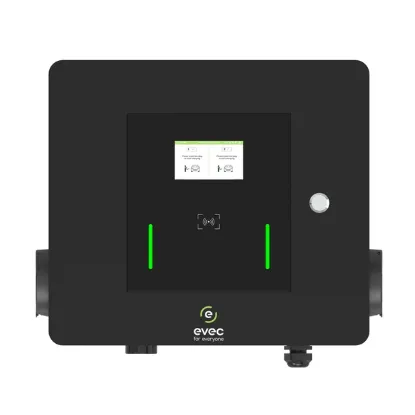
Dual wall chargers for two bays from one wall position
The evec EDW01 7.4kW dual socket wall charger suits shared sites where two AC charge points are needed but 7.4kW charging is enough for the dwell time. It can suit workplaces, hotels, apartment-style parking and shared bays with a practical wall nearby.
The evec EDW02 22kW dual socket wall charger is the higher-output dual wall option for suitable three-phase sites. It is more relevant where vehicles need faster AC charging and the site has the electrical capacity to support the design.
For broader commercial options beyond evec, see the LAMPS guide to the best commercial EV chargers.
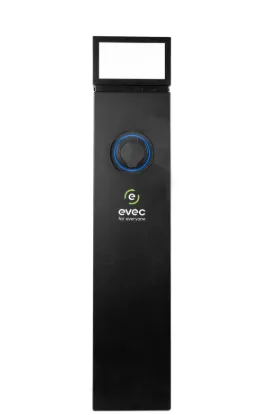
When to choose an evec pedestal charger
Choose an evec pedestal charger when the charger needs to sit beside the parking bay rather than on a wall. Pedestals are common in open car parks, hotel parking areas, visitor bays, business parks, apartment-style parking and commercial sites where the building is not close enough to the bay.
7.4kW evec pedestal chargers
The evec ESP01 7.4kW single socket pedestal is the simpler one-bay option. It suits lower-demand shared bays where a single freestanding charge point is enough.
The evec EDP01 7.4kW dual socket pedestal is better where two vehicles need access from one freestanding unit. It suits longer dwell parking where two charging points are more useful than faster charging.
22kW evec pedestal chargers
The evec ESP02 22kW single socket pedestal suits three-phase commercial sites that need one freestanding AC charger with higher output potential.
The evec EDP02 22kW dual socket pedestal is the stronger choice for two shared commercial bays where a site has three-phase capacity and wants faster AC charging from one pedestal position.
Pedestal installations should be planned around bay layout, cable reach, impact protection, trenching, ducting, signage, accessibility and future expansion. EV cabling and circuit protection should be considered early, not left until the charger has already been selected.
When to choose a 40kW evec rapid charger
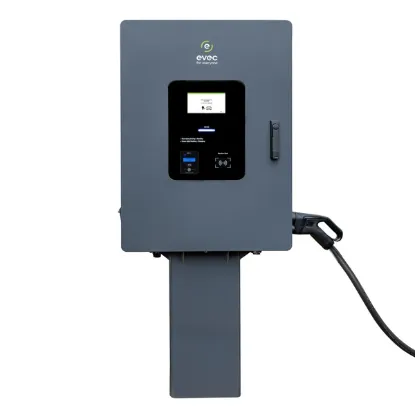
Choose an evec 40kW DC rapid charger when AC charging is too slow for the site’s dwell time. DC rapid charging is normally a commercial decision for locations where drivers need a meaningful top-up during a shorter stay, such as retail, leisure, public parking, fleet operations, forecourts or visitor charging.
evec VEC40DC-S 40kW single-gun DC rapid charger
The evec VEC40DC-S 40kW single-gun DC rapid charger suits one-bay rapid charging. It is the more straightforward rapid option where the site wants one vehicle charging at a time, with simpler bay management and a clear user journey.
evec VEC40DC-DG 40kW dual-gun DC rapid charger
The evec VEC40DC-DG 40kW dual-gun DC rapid charger suits sites where one rapid cabinet needs to serve two vehicles. This can help reduce waiting at busier locations, although the available output is shared when both guns are in use.
A 40kW DC charger should not be specified as a like-for-like alternative to an AC wall charger. It needs a more detailed site assessment covering supply capacity, installation location, protection, connectivity, civil works, parking control, payment operation and ongoing management.
Adding payment terminals for public or workplace charging
Payment terminals become relevant when a site wants to charge users, provide public or semi-public access, or manage charging across multiple bays. For purely private workplace charging, RFID access or app-based control may be enough. For public-facing sites, contactless payment requirements should be checked before the charger goes live.
The UK Public Charge Point Regulations require contactless payment for new public charge points of 8kW and above deployed after 24 November 2024, and for public charge points of 50kW and above. The rules apply to public charge points, not purely domestic or exclusively private workplace charge points, so operators should check whether their site is public, semi-public or private before specifying the payment setup.
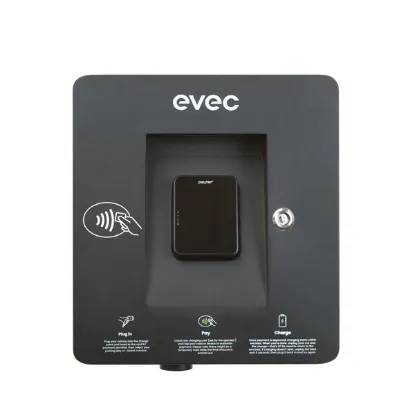
evec PAY-WAL wall payment terminal
The evec PAY-WAL wall payment terminal suits sites where the payment point can be fixed to a nearby wall. It can be a practical option for car parks beside buildings, hotels, retail sites, service yards and retrofits where a wall position is already available.
evec PAY-TWR pedestal payment terminal
The evec PAY-TWR pedestal payment terminal suits open bay layouts where there is no convenient wall. It can be positioned closer to the charging bays, which is often more suitable for forecourts, open car parks and island-style charger layouts.
Final recommendation by use case
| Use case | Recommended evec option | Why it fits |
|---|---|---|
| Standard UK home, tidy cable-free look | VEC01 7.4kW socketed | Single-phase home charging with removable cable flexibility. |
| Standard UK home, easiest daily use | VEC03 7.4kW tethered | The fixed Type 2 cable is ready for regular charging. |
| Three-phase workplace with mixed users | VEC02 22kW socketed | Higher AC output potential with separate cable use for different vehicles. |
| Three-phase fleet or assigned staff bay | VEC04 22kW tethered | A fixed lead suits repeat users returning to the same bay. |
| Two workplace bays from a wall | EDW01 7.4kW dual wall or EDW02 22kW dual wall | Two sockets from one wall-mounted charger, with 7.4kW or 22kW selected around supply and dwell time. |
| Open car park with no suitable wall | ESP01, EDP01, ESP02 or EDP02 | Pedestal chargers place the charge point beside the bay rather than relying on a building wall. |
| Commercial site needing faster turnaround | VEC40DC-S or VEC40DC-DG | DC rapid charging suits shorter dwell sites where AC charging would not meet the operational need. |
| Public or semi-public charging with card payment | PAY-WAL or PAY-TWR | Wall or pedestal payment terminals support contactless payment layouts across charger groups. |
FAQs
Which evec EV charger is best for a UK home?
For most UK homes, start with a 7.4kW single-phase evec charger. Choose the VEC01 socketed model for removable cable flexibility, or the VEC03 tethered model if the driver wants a fixed Type 2 lead ready for regular charging.
Do I need a 7.4kW or 22kW evec charger?
A 7.4kW evec charger is usually the practical option for single-phase home charging and longer dwell parking. A 22kW evec charger should be considered where a suitable three-phase supply is available and the vehicles can accept higher AC charging rates.
Is a socketed or tethered evec charger better?
Socketed is better for cable flexibility, mixed users and a tidier charger face when not in use. Tethered is better for repeat users who want the cable already attached. For homes, tethered is often more convenient; for shared commercial bays, socketed can be easier to manage.
When should I choose an evec pedestal charger?
Choose an evec pedestal charger when the charge point needs to be positioned beside the bay rather than fixed to a wall. This is common in open car parks, hotels, visitor parking, business parks and shared residential parking areas.
When does an evec rapid charger make sense?
An evec 40kW DC rapid charger makes sense where vehicles need faster turnaround than AC charging can usually provide. It is usually a commercial choice for public parking, retail, leisure, fleet, forecourt or visitor charging sites rather than a standard domestic installation.
Do evec chargers need special EV cabling and protection?
Every EV charger should be specified with the correct cabling, protective devices and installation design for the site. The requirements depend on charger output, supply type, cable route, earthing arrangement, load management and whether the installation is domestic or commercial.
To specify the wider job, browse LAMPS’ home EV chargers, commercial EV chargers, EV circuit protection and EV cabling ranges. For installation support, see EV charger installation.